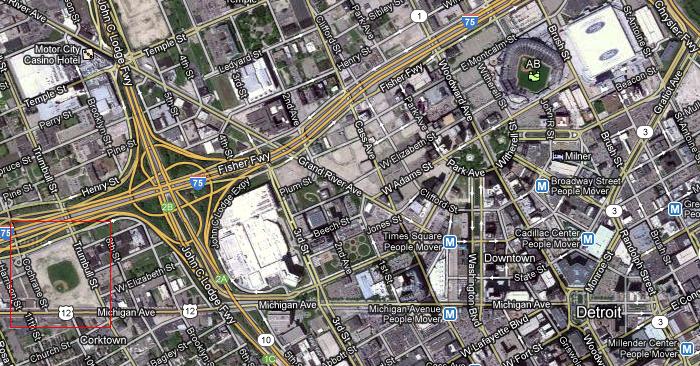
We won't be seeing a game at Tiger Stadium, but we may have to make the short journey from Detroit's downtown to see where Tiger Stadium used to stand, "The Corner" of Michigan and Trumbull. There is a large lot just west of downtown that looks like rough gravel surrounding a baseball field. Of course, this is what I assume is there based on what I can see on Google Maps.
Although Comerica Park was completed in 1999, and the Tigers began playing on that new field in 2000, Tiger Stadium sat empty until 2007 while multiple preservation groups tried to save the park. The park was taken apart and demolished over the next 2 years, completing in September 2009. But the demolition effort took only the building, not the field it surrounded.
Maybe this last step wasn't completed because the recession hit Detroit especially hard, or because a few representatives of the city desired to hold onto this piece of historic Detroit strength in the hard times, or because city planning office hasn't figured out what to do with this piece of land. Whatever has prevented the remainder of this field from being swept into the history books and re-purposed is a small gift to baseball enthusiasts that thrive on learning (and seeing) the history of the game.
This year, Tiger Stadium would have turned 100. Built in 1912, the same year as Fenway, it had a very modest turnout to celebrate its birthday in April, only around 200 people. They ate grilled hotdogs, played catch, ran the bases, and participated in a commemorative flag raising on the pole that still exists in the old center field. Thanks to the Tiger Stadium Historical Society, the grounds are maintained by volunteers and the flag still flies. I'm uncertain if the grounds are open to the public to visit. I read in one blog that the fence has been opened and in another blog I see the "No Trespassing" sign on a locked fence. I will report on this when I get there.
It is city property and the city has rejected multiple proposals to use the land while still preserving the field. One proposal included a 'living building', charter school, retail, and housing that surrounded the field, which could then be used as a community park. The cost of the proposal was $65.3 million and was rejected because the city could not see a return on their investment.
Another plan rejected was one to make it a "new ballpark for Detroit's youth". So, instead, the lot sits empty and ugly, providing no payback at all to the city.
It is very sad that a piece of history is in limbo because the city cannot reach consensus on what to do with a simple piece of land with a small patch of grass and gravel that retains the appearance of a baseball field. The Tigers have money to help preserve the land, but the organization does nothing because 'it is the City's land.' Until a decision is made, those of us with interest in history can visit this small patch of grass and imagine we are stepping onto the field in the Stadium where Ruth hit his 700th Home Run, where Lou Gehrig voluntarily benched himself after 2,130 consecutive games, where Prince Fielder's father was a star and Prince, then 12 years old, hit home runs at batting practice, and where Ty Cobb scored the first run in the park by stealing home. I'll play ball, even if the city won't.
Even though I root for The Cubs, I am a baseball fan, and my bucket list includes a visit to each Major League ballpark in the MLB (fitting in visits to Minor League teams along the way). These are my visits to Major League Baseball fields and the cities they reside in: what to do, where to go, and how to get there. Each field has its own character, and there are characters among each team's fans!
Showing posts with label Field. Show all posts
Thursday, July 5, 2012
Tuesday, July 3, 2012
Old Comiskey Park
Being a Cubs fan, I am incredibly lucky (if you don't count the whole "not winning a Pennant or World Series in forever" thing). I am able to experience the history of my team every time I go to a game. The old park may have been built onto, "enhanced", modernized. The old field may have been "rebuilt" by the magician grounds man to deal with the rain Chicago experiences. But the old park is still there, and the old park is still named Wrigley Field. And I know that technically, the old old park, the last one to see a World Series winning team is gone, but it ceased to be in 1916.
White Sox fans, any that have been alive and going to games since before 1991 have seen their old park disappear, their old pre-game / post-game bar disappear, and all of that history disappear along with them. As the predecessor to Yankee Stadium, this field was demolished in 1991 and rebuilt right across the street.
The only thing that remains from the destruction is a single tree that used to stand outside the park's right field corner gate, and now shades the corner of the parking lot. Now, the only thing to remind fans of the old location is a patch of stained concrete.
Even the name has changed for this field. When it was rebuilt, it was still named Comiskey, after the owner, Charles Comiskey. Not long after, in 2003, U.S. Cellular purchased the field and renamed it. While I can't be too upset about commercialization, (after all, Wrigley was named after a chewing gum manufacturer) there is something to be said about keeping the old name, even under new ownership.
McCuddy's was the tavern across the street from the old field, for which the new field stands as a gravestone. This pub was demolished in 1989 and was never rebuilt. It had a rich history itself, including famous patron Babe Ruth, who drank there between games of a doubleheader.
I wondered why it was so difficult to find a pub to visit pre and post game close to the field. Unlike Wrigleyville, which is filled with eating and drinking establishments, this field seems to be set down in the middle of a normal neighborhood that just happens to be next to the Dan Ryan Expressway and just off the Red Line. It is not a destination "area," just a single building, and when the game is done, are the fans done too? This is one thing I want to figure out in August. Do the fans really make the half mile trek to Schaller's Pump or to Shinnick's Pub before or after the game?
While I visit the field, I will keep this history in mind, pay homage to the remnants of the old field, before and after I root for the home team as they play that team I love to hate, the Yankees.
White Sox fans, any that have been alive and going to games since before 1991 have seen their old park disappear, their old pre-game / post-game bar disappear, and all of that history disappear along with them. As the predecessor to Yankee Stadium, this field was demolished in 1991 and rebuilt right across the street.
The only thing that remains from the destruction is a single tree that used to stand outside the park's right field corner gate, and now shades the corner of the parking lot. Now, the only thing to remind fans of the old location is a patch of stained concrete.
Even the name has changed for this field. When it was rebuilt, it was still named Comiskey, after the owner, Charles Comiskey. Not long after, in 2003, U.S. Cellular purchased the field and renamed it. While I can't be too upset about commercialization, (after all, Wrigley was named after a chewing gum manufacturer) there is something to be said about keeping the old name, even under new ownership.
McCuddy's was the tavern across the street from the old field, for which the new field stands as a gravestone. This pub was demolished in 1989 and was never rebuilt. It had a rich history itself, including famous patron Babe Ruth, who drank there between games of a doubleheader.
I wondered why it was so difficult to find a pub to visit pre and post game close to the field. Unlike Wrigleyville, which is filled with eating and drinking establishments, this field seems to be set down in the middle of a normal neighborhood that just happens to be next to the Dan Ryan Expressway and just off the Red Line. It is not a destination "area," just a single building, and when the game is done, are the fans done too? This is one thing I want to figure out in August. Do the fans really make the half mile trek to Schaller's Pump or to Shinnick's Pub before or after the game?
While I visit the field, I will keep this history in mind, pay homage to the remnants of the old field, before and after I root for the home team as they play that team I love to hate, the Yankees.
Subscribe to:
Posts (Atom)


